Point of view · June 2026
Big Enough to Matter, Small Enough to Trust
You found a real problem. Big, expensive, the kind an executive loses sleep over, and you can prove the math. You still cannot get in the door.
The reason is a relationship most founders never name: pain and trust pull in opposite directions. The bigger and more central the problem, the more it is worth, and the less a company will hand it to someone they have never heard of.
Pain gets you the meeting.
Proximity to the core loses you the deal.
I have lived both ends of that line. As a BCG consultant, the firm’s name got me into the room before I said a word. Later, building a startup, I had to earn every meeting myself. Here is the whole of it, up front: the one corner an unknown can win is where the pain is high but the problem sits away from the core. The rest is how to find that corner, how to earn your way in, and the one moment the rules bend. If you take one rule from it, take it now: enter at the most valuable problem a buyer will currently trust you with, and never take it unless you can name what it earns you next.
Why the core is guarded
Geoffrey Moore, whose Crossing the Chasm became the field manual a generation of tech companies used to bring new products to market, later drew a line through everything a company does. On one side sits the core, the work that creates its edge. On the other sits context, everything necessary but not differentiating. His counsel to executives was to hand the context to specialists and keep their own people on the core. The idea beneath it is older still, and owes as much to Clayton Christensen, the Harvard professor behind disruption theory, who showed that outsiders rarely get in by storming the center. They take the low-status foothold the incumbent is glad to cede, and climb from there. None of this is mine.
What the strategy shelf skips is the view from outside the table. Companies outsource the core constantly, Amazon runs their infrastructure, contract labs run their trials, the brand-name firms run their strategy, but only to names that cannot fail an audit. The core is not closed to outsiders. It is closed to unknown ones. That inverse is the idea worth taking from here: the more a problem is worth, the less a company will let a stranger near it, so an unknown’s real work is finding the valuable problem whose door is, for now, open, and knowing what can open the rest.
The map, and the trap inside it
Plot two things: how high a problem sits on the executive’s stack, and how close it sits to the core. The corner where pain is high and proximity is low is the one an unknown can win. Call it the Open Door: big enough to fund and to get a meeting, peripheral enough that they will trust an outsider with it. The map below plots all four corners.
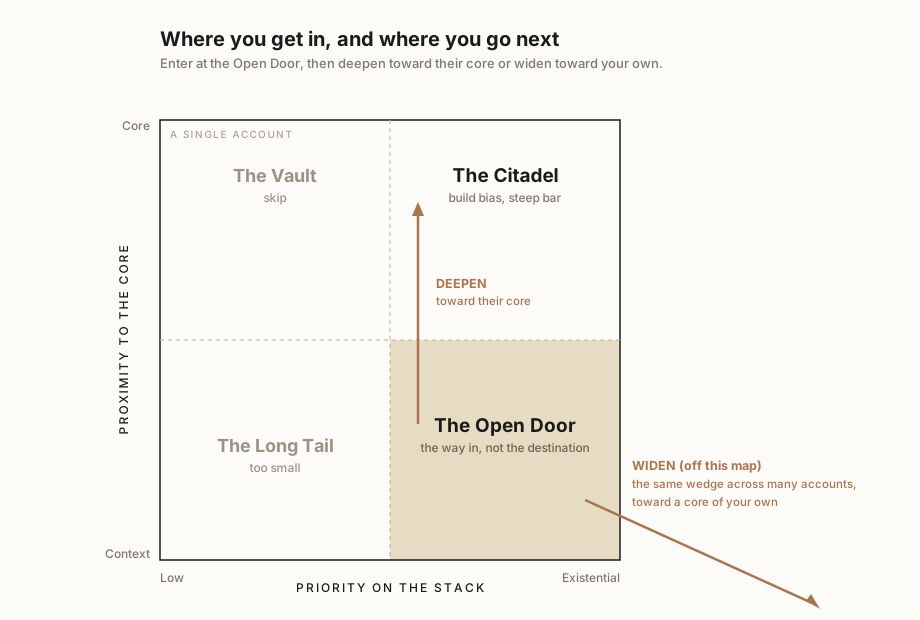
The Open Door is only a starting point. From there it grows toward one of two different cores. You can deepen, moving toward the customer’s core, the one this map plots. Or you can widen, scaling your slice of their context across the whole market until it becomes a core of your own. That second move is one the map cannot show, because the map is a single account and widening happens across thousands of them. Payroll is context to every company that buys it, and the entire business of the company that sells it. The context trap is reaching neither: a wedge too shallow to deepen and too ordinary to own. The champion moves on, the core team keeps building without you, and you spend years in a room with a price ceiling. Want a line to one of those cores before you walk in. Take the beachhead only if you can already see the path beyond it.
The other corners are quick. High priority and core is the Citadel: most budget, steepest bar, where an unknown loses on a cold pitch. Low priority and context is the Long Tail: too small to fund. Everything that matters happens on the line between the Open Door and the Citadel.
One industry, two doors
I spent three years selling Flashfood into grocers, and watched the same shape room after room. It took us from a handful of stores to past a thousand, so this is ground I walked, not a model I read about. Grocery is where I lived it, but the reflex shows up everywhere: airlines guard revenue management and pricing, telcos their network, retailers their merchandising. Same instinct each time, keep the stranger away from the engine.
Their e-commerce roadmap was the Citadel, and they guarded it. COVID had just sent online grocery from a low single-digit share of spending into the teens, and owning the digital customer had become existential, because the alternative was depending on a delivery platform that sat between them and their own shopper. If I had walked in pitching that core problem, I would have been clearing a far higher bar against bigger, better-known players already at the table, and I doubt I would have broken through.
Food waste was a path with less resistance. It was real money and a public promise, and despite genuine intentions they were falling behind on it, so there was appetite. But it was never the biggest fire and never the engine. That was the Open Door.
Watch what happened to that Citadel, because it is the part the decks leave out. Grocers raced to own the digital core themselves. Kroger went the build route, investing hundreds of millions in automated fulfillment with Ocado. Over those same years the delivery platforms, Instacart and DoorDash, kept getting better and more trusted, so leaning on them grew steadily less risky. By 2025 Kroger had publicly scaled back that buildout and closed several of the facilities. This is no knock on Kroger or Ocado. The bet was reasonable and could have broken the other way. The pattern is the point: the build-it-ourselves reflex runs so strong that an incumbent will spend a fortune and years on the core before it accepts a partner. An unknown pitching to own that core in 2020 had almost no chance, because the hands the grocers reached for were ones they already trusted.
The locked door, and the two ways in
Being right does not get you in by itself. Caper built a genuinely good product, a cart that let shoppers skip the checkout line, and lined up pilots with serious grocers on three continents. It was earning real traction, and might well have climbed to the in-store core on its own. There are two honest ways through that door: you earn the keys over years, or a player who already holds them brings you inside. Caper was acquired mid-climb. Instacart bought it for a reported 350 million dollars and plugged the cart into a platform grocers already trusted. That is a real outcome, and for many founders a very good one. See it clearly for what it is, though: the keys that opened the core were Instacart’s, earned over years, and Caper walked in on them. Getting bought into the core is no failure. It is one of the two ways in, and often the faster one. You just cannot count on it. The right holder of the keys buying at the right moment is its own kind of luck, so build as though you are earning your own.
Know when the wall cracks, and when it does not
A platform shift, and AI is the largest in a generation, is the one force that lowers the bar at the core. The incumbent cannot build fast enough, the status quo starts losing in real time, and a buyer who would never have let a stranger near the engine starts taking those meetings. The core forgets to lock the door.
You can watch it now. AI is coming through the Open Door first, support, coding, drafting, the back office, where the pain is loud and the work sits off the core. The richer ground stays guarded, credit decisions, diagnosis, anything regulated or load-bearing, and reasonably so, because that is where letting an unproven system too close is reckless, even when it may be where the value is highest. That tension is the opportunity, and it is why the discipline that follows matters more in this shift, not less.
This is where most founders misread the moment, and where an operator’s discipline is the edge. A cracked door is not an open one. A frightened incumbent moves fast toward the safest hand it can find, the hyperscaler, the integrator, the team it just funded internally, not a seed-stage unknown. The window for someone with no track record is real but narrow, and in a gold rush nearly everyone believes it is open for them. The expensive mistake of this era will not be missing the core. It will be forcing your way at a core that was never going to let you in, and burning the runway you needed for the door you could actually walk through.
Three questions tell you whether the window is open or only in your head:
- Will the incumbent actually solve this in time on its own, by building it or buying from a name it trusts? Not could they in theory, but will they, before you could prove yourself? Kroger could have built its way out and chose to pull back instead. If the answer is yes, the window is not yours.
- Is the buyer losing right now, or only theoretically exposed? Present-tense bleeding opens doors. Someday-threats do not.
- Do you hold something the safe hand cannot copy fast, proprietary data, a wedge, a marquee design partner already inside? If your edge evaporates in a quarter, the window favors the incumbent’s incumbent, not you.
Three honest yeses and the core is briefly open. Even then you do not force it. You aim sooner than the rules normally allow and still enter the way you always would: a contained first scope, a design partner who lends you their name, terms with your own skin in them, a clock you respect. A platform shift changes your starting rung and shortens your timeline. The trust bar stays exactly where it was. What changes is that a door usually bolted shut swings open. The winners are the ones who read the moment correctly, saw it was open for them, and were let in a step at a time.
How to earn the core
Open Door or cracked-open Citadel, the mechanic is the same. The problem sets a trust bar that rises toward the core, and you win when your trust capital reaches it. Where you start on that bar decides much of the rest. A new or AI-native startup begins on borrowed credibility alone, its team and its backers, and climbs by earning the rest: design partners, traction, references, a track record. What finally clears the bar before you say a word is brand: the point where you have become the default answer to the problem, the name a buyer reaches for without shopping. That is the real aspiration, to be the industry standard for the thing you solve. The bar also sits lower at a buyer that cannot staff the build than at a giant that can, and lower for a known name than an unknown.
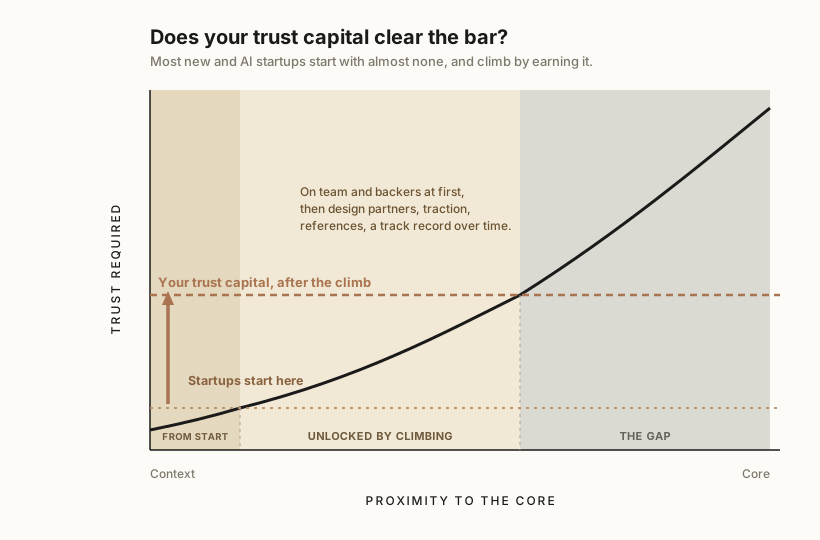
Short of the bar, you have three moves. Lower it, by entering at the adjacent work next to the engine rather than the engine itself. Buy down the gap, with proof at their scale: a named pilot, outcome-based pricing, or a co-signer who lends you credibility until you own some. Or pay in patience, and price the long climb into your plan honestly.
Clearing the bar gets you in. What makes getting in worth it is a credible path to scale, and most paths are wishful. To deepen, the next problem inward must be one the buyer already feels, and the beachhead must earn you an asset, data, an integration, a relationship, that lowers the bar on it. Palantir deepened this way, entering one guarded core and earning further in over years. To widen, the same wedge must be wanted by a large, reachable market, and something must compound as you scale, data, a network, switching costs, distribution, so each new customer makes you harder to displace rather than easier to copy. Stripe widened this way, turning payments-context into its own core across millions of businesses that were never in the payments business, much as ADP did with payroll. Either path is a real company. Having neither is the trap.
Do not sign it unless you can name what it earns you next: a deeper problem in this account, or the next thousand accounts like it.
Back to the meeting
The meeting went well again and the deal is not moving, and the temptation is to sharpen the pitch. Sometimes the pitch is the problem, so check that first. But when a good pitch keeps stalling, consider that the problem may not be the pitch at all. Look at where the problem sits. In the Long Tail, no pitch creates urgency that is not there. In the Citadel on an ordinary day, unless you hold a rare reason for them to let you straight in, stop selling and go find the adjacent door. In the Open Door, the slide was never the work. The work is drawing the line to the core before you walk in.
An unknown does not get to start at the core, the customer’s or its own. It earns its way there, big enough to matter, small enough to trust, pointed at that core from the first day.
So before the next meeting, the only question that matters: which corner is your deal actually in, and do you know the door it grows toward?
If this is live for you
If you are a founder trying to figure out which door you are standing at, whether the AI window is really open for you or only in your head, or whether your beachhead has a path to a core, that is the conversation I like most. And if you are on the other side of the table, deciding which AI vendor to let near your core, the same map tells you which ones are worth trusting. Either way, send it over and I will think it through with you.